
San Ramon Previous Residents: Source Map
Previous residents are not held in one San Ramon list. The source that answers an ownership question is often different from the source that answers an occupancy question. Start with the time period and the claim you need, then choose the record whose fields can support that claim.
| Source | Years It Covers | Where Held | What It Shows |
|---|---|---|---|
| Recorder deed and index | Linked-person results 1986-present; APN deed mode 3/3/1997-present; older modes vary | Contra Costa Clerk-Recorder | Titleholders, party roles, recording dates, instruments, and legal descriptions. |
| Local and reverse directories | Exact San Ramon runs not verified | County Library, Historical Society, State Library | Subscribers or occupants by name, street, and house number when a volume includes the area. |
| Federal census | 1790-1950 currently public | NARA and library databases | Household members, relationships, ages, birthplaces, occupations, and location. |
| San Ramon permits | Current digital and archive range not published | City Building and Safety | Construction, remodeling, applicants, contractors, inspections, and dates. |
| Public civil court records | After 11/13/2007 generally online; earlier files physical | Contra Costa Superior Court | Probate, disputes, judgments, case parties, and event context. |
| Obituaries and probate | Collection-dependent | Library, newspapers, court, and historical collections | Kinship, former residence, death dates, estate notices, and trail endpoints. |
For a recent transfer, the deed index is the cleanest starting point. For a household that may have rented or shared an address, directories and census records are stronger. For a nineteenth-century parcel, the county deed books, legal description, probate, and regional history shelves matter more than the current street label.
The Contra Costa County Historical Society is a useful regional repository for maps, newspapers, directories, manuscripts, photographs, and vertical files. Its holdings can connect a San Ramon address to a ranch, subdivision, school, organization, or family without pretending that the collection is a complete residents roll.
The Historical Society capture below shows the countywide context in which San Ramon house history is often found.
That regional shelf is especially important because the city incorporated in 1983, while county and valley records predate the modern municipal series.
Note: A source’s coverage date describes where to search, not a complete count of every household that used an address.
Trace San Ramon Previous Residents Through Deeds
The deed chain is the strongest backward route for title, but it is not a complete list of previous residents. Begin with the present APN and vesting deed, not a guessed name. The Contra Costa Clerk-Recorder recorded-document index supports party, document, date, book and page, APN, map, and legal-description modes. The linked-person workflow covers 1986-present, while APN deed mode reaches 3/3/1997-present. Older books and modes vary, and the county notes that some property records reach the 1800s.
- Normalize the current USPS situs address and confirm the city or county jurisdiction. Capture the APN, subdivision, lot or block reference, map-book clue, and any present legal description.
- Obtain the current vesting owner or deed reference through the lawful public assessment-roll counter or the recorder index. The Assessor Maps and Property Information page explains the APN and street-address tools, but its web presentation omits owner names, so do not treat a parcel card as the ownership answer.
- Open the current deed and record the grantor, grantee, recording date, document number, instrument type, and legal description. Compare the property description, not just the names.
- Search the seller as a prior grantee, then repeat the process backward. Narrow by date and document type when a common surname produces several candidates.
- When a mode cutoff blocks the next link, move to Old Book, Book and Page, legal-description searching, the counter index, or older deed books and microfilm. Mark the point where online coverage ends instead of inventing an exact cutoff.
- Grantor and grantee
- The grantor transfers or releases an interest. The grantee receives or holds the interest named in the instrument.
- Chain of title
- The linked sequence of recorded transfers that connects a current titleholder to earlier titleholders.
- Legal description
- The formal land description, such as a lot, tract, map, or metes-and-bounds reference. It can stay useful when a street name changes.
- Criss-cross directory
- An address-ordered directory, usually street then house number, that can connect an old address to a subscriber or occupant.
- Enumeration district
- A census area assigned to an enumerator. It helps locate a household when a historic street search is not exact.
Names alone create false chains. A person may grant a deed as an estate representative, trustee, lender, or business party. A matching legal description, date sequence, and document image are the safeguards.
Note: A recorded transfer proves a documented interest, while occupancy requires a separate dated source for confirmation.
Find San Ramon Past Households in Directories
A deed can show who held title while a reverse or criss-cross directory can show who used the address. Telephone directories are subscriber sources, not a full household census. A listed name may be a spouse, a business, or a single subscriber among several people at the same location. Read the edition’s abbreviation key before treating a mark as an owner, resident, boarder, or business entry.
Exact San Ramon directory years were not verified in an official online finding aid. Ask the San Ramon Library, the County Library catalog, the Historical Society, or the State Library about publisher, edition, geographic coverage, and shelf location. Search regional terms such as San Ramon Valley, Danville, Contra Costa, Tri-Valley, and San Ramon Village. The collections themselves are described on the San Ramon city directory page, while an address-history workflow uses only the entry fields needed to test a location.
When a volume is found, capture the exact name, initials, spouse notation, occupation, address, telephone, business cross-reference, and first or last appearance. Keep a copy of the page citation. A missing name is not proof that a person was absent: the road may not yet have existed, the volume may not cover the area, or the household may not have subscribed.
Pair San Ramon Residents With Census Years
The public federal census supplies the household layer that a deed cannot. As of the research date, schedules through 1950 are public under the 72-year rule. They can show names, relationships, ages, birthplaces, occupation, and location. A census entry is still a dated snapshot. It should be paired with an address source rather than treated as proof that a person lived at a parcel for the whole decade.
Use the directory and census together when researching previous residents of an older San Ramon address. The process below is designed for a house whose street name, number, or place label may have changed.
- Write down the exact directory edition and address entry, including a spouse, initial, occupation, or telephone detail that can separate people with the same name.
- Choose the nearest public census year, then search by person, place, and likely enumeration district. Keep San Ramon Valley, Danville, county, and older community names in the search notes.
- Compare household members, ages, relationships, and occupation with the directory entry. Treat a close match as a lead until address, parcel, or family evidence agrees.
- Use a deed for title, a permit for construction activity, and newspapers or obituaries for movement, death, marriage, or estate events. Each source answers a different part of the address story.
Newer Dougherty Valley streets will not appear in early census or directory volumes because the subdivision and road network had not yet been built. An older address may instead sit under a county, ranch, school district, or valley place name. That is a geography problem, not evidence that the household never existed.
Note: An absent directory or census hit can reflect a missing volume, changed place name, or unbuilt street rather than an empty parcel.
Date San Ramon Addresses With Permits and Annexations
Permit history can place a building or remodel between two directory sightings. San Ramon Building and Safety records may include the address, permit type, applicant or contractor, issuance, inspection, and status. The city does not publish a verified starting year for its permit archive. Plans may have privacy or security limits, and pre-1983 construction was generally under county jurisdiction. Some Dougherty Valley projects also remained county projects until finaling.
The city’s public-record route is useful when a particular permit, planning file, or address event is known. The San Ramon City Clerk request page accepts a defined request online and through the City Clerk by email, fax, mail, or inspection. The city lists a 10-day determination rule with a possible 14-day extension, weekday inspection from 8:30 a.m. to 5 p.m., and $0.10 letter-size black-and-white copies.
The city request channel can be a dated bridge between a parcel and a household story. Its form asks for date, name, address, phone, email, and a specific description of the information requested. The public-records request capture below shows the route used for a defined existing record.
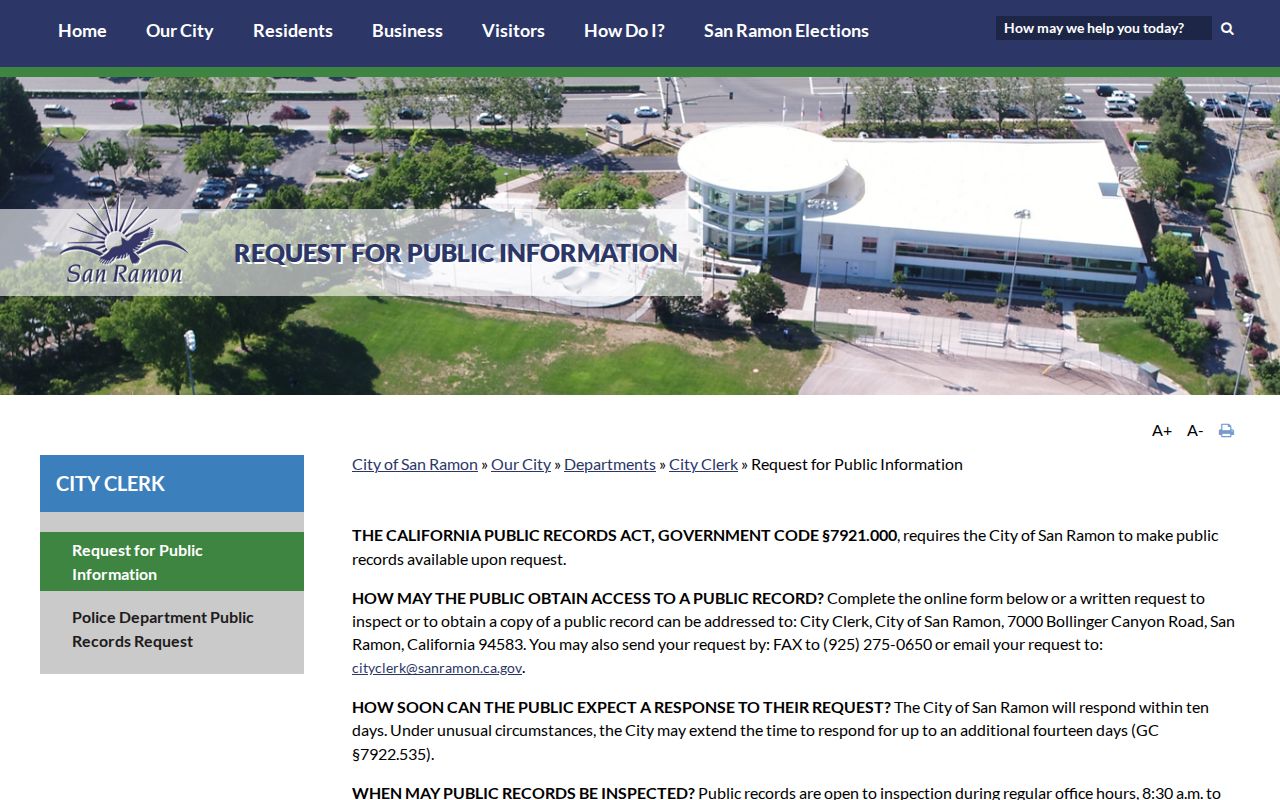
If a city file does not exist because the event predates incorporation or was handled by the county, move to Contra Costa Building, planning, assessor, fire-district, or recorder sources. The annexation sequence also matters. Canyon Lakes phases, Central San Ramon, Thomas Ranch, Dougherty Valley, Henry Ranch, and Faria Preserve entered the city in different years, so neighboring parcels can have different archive paths.
Use San Ramon Court Files Carefully
Court records can explain why an owner disappeared, why an estate changed title, or why a person was tied to an address at a particular time. San Ramon has no municipal court. State trial matters are in the Superior Court of California, County of Contra Costa. Public civil documents filed after 11/13/2007 are generally viewable through the Court Public Portal. Older physical civil files are stored off-site and ordinarily take about 10 business days to retrieve.
The Contra Costa Superior Court online case information page is a party and case pointer, not the full file. Search by case number when known, or by party name with case type and date clues. Probate, family, juvenile, confidential, and sealed materials have category-specific limits. The result can show party roles, filing dates, hearings, register entries, document titles, and a public image where one is available.
The court information capture below illustrates the public case-information route used to test a dated event.
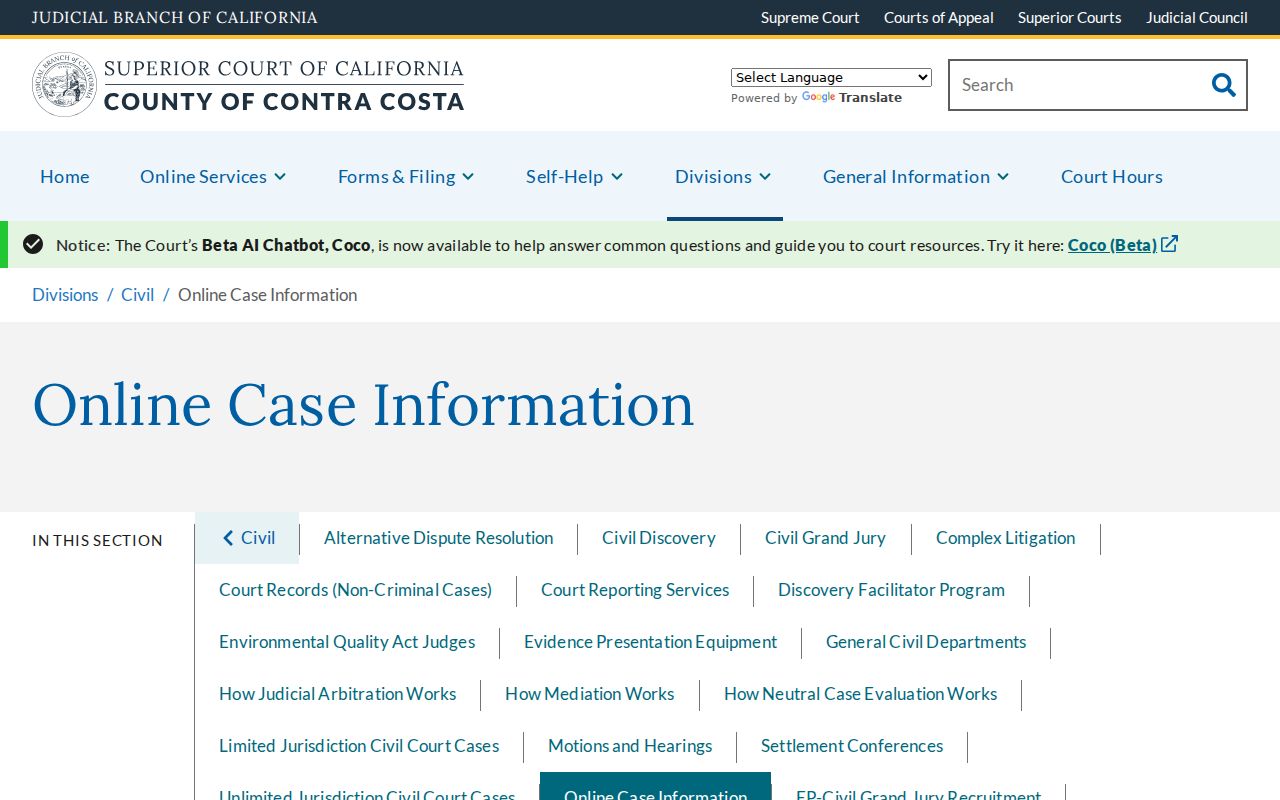
For an older or unavailable file, REC-01 supports a mail request with case number, case name, case type, requester details, and documents sought. The court lists a $15 file or name search per case, $0.50 per page, and separate certification charges on the current form. Use the court file to confirm an event, then return to the deed, probate, obituary, or address source that connects it to the house.
San Ramon Elections and Past Households
Election records can explain the geography of a current registration, but they do not create a casual historical household list. California’s My Voter Status is an authenticated self-lookup. It asks the voter to match identity fields and returns that voter’s status context. It is not a browseable name-and-address directory and does not prove that a past resident occupied a house.
The Contra Costa County Elections office administers registration, precincts, and list maintenance. A permitted voter-file request must identify the requester, organization, geography, statutory purpose, security controls, and authorized users. Elections Code section 2194 and Government Code section 7924.000 limit release and protect specified address, contact, identifier, and signature data.
The county elections capture below is a useful reminder that current election services and an address-history search are separate research paths.
For previous residents, use a voter clue only as a lawful, dated corroboration when access is allowed. Deeds, directories, census schedules, and obituaries remain the better sources for household history. An inactive or missing registration is not proof that a person did not live at an address.
Close a San Ramon Address Trail With Obituaries
Obituaries and probate files often close a house-history trail. A notice may name relatives, a former residence, a service location, or a move from the valley. A probate petition, creditor notice, inventory, or recorded transfer can connect that family clue to a title event. Neither source should stand alone when a name is common. Compare dates, spouse or parent names, address wording, and the legal description in a later deed.
San Ramon Library keeps current Herald or Tri-Valley Herald issues plus one year in paper. NewsBank’s San Ramon Valley Times coverage begins in June 1995, and cardholders can search post-June-1995 Contra Costa Times obituaries. Earlier issues require microfilm, and library staff do not perform the search. The California State Library genealogy resources and the Historical Society can help when a county newspaper or local file is not at the branch.
House-history use. Previous-resident research in San Ramon is appropriate for family history, preservation, genealogy, and personal curiosity. Do not use an address trail to watch, intimidate, harass, or track a living person.
A clean endpoint records what the source actually says, the date it says it, and the question it cannot answer. That habit keeps an obituary from becoming an unproved current-residence claim and keeps a probate name from being mistaken for every person who lived in the house.
San Ramon House-History Research Gaps
Several gaps remain material for a serious address history. They should be recorded plainly so a future researcher knows what must be checked at a counter, in a catalog, or with staff rather than treating an absent result as a fact.
- The exact earliest online Contra Costa deed-index year was not documented. Mode-specific coverage is known, but the full system cutoff is not.
- The city has not published a verified starting range for San Ramon permit archives, and pre-incorporation plans may remain with county departments.
- No official online finding aid verified exact San Ramon criss-cross or reverse-directory years, a complete Polk run, or a sample local directory page.
- No verified standalone San Ramon Sanborn sheet years were located. Do not cite a map year until a library or archive confirms it.
- No authoritative citywide street-renumbering year, postal realignment history, or exhaustive obituary-index run was located.
The practical answer to each gap is a narrow request: identify the APN and date range for the recorder, ask the library for the exact edition and shelf, request a defined city permit record, or search a named newspaper issue. A San Ramon house history becomes stronger when every blank is labeled as unverified instead of filled with a plausible but unsupported year.